


Urban trees don’t fail because of bad luck – most are set up to fail before they’re even planted. Traditional planting pits work against trees from the start: soil compaction, limited rooting volume, and conflicts with pavement and utilities all conspire to cut a tree’s life short.
The root cause, quite literally, is running out of room. A successful canopy requires adequate soil volume below ground. Natural root growth extends outward two to three times the drip line, and trees need uncompacted soil with the right balance of aeration, moisture, and nutrients to reach that potential. In the urban environment, those needs run headfirst into the reality of compacted hardscape.
The consequences are measurable: trees planted in compacted conditions have an average lifespan of just 5–7 years, never reaching full species maturity and requiring ongoing replacement at a cost that far outweighs any upfront savings on the planting system.
Two subsurface systems are commonly specified to address this problem: structural soil and soil cells. They are often treated as equal alternatives, but the research — and the real-world results — tell a very different story.
What Is Structural Soil?
Structural soil is made up of 80% crushed stone and 20% soil, compacted to 95% proctor density. The compacted rock provides structural support with small void spaces for soil, leaving tree roots to grow in those gaps. Trees may perform adequately in the early years, but once that limited soil is exhausted and the root system becomes fragmented, decline typically follows.
The compaction required to support pavement also pushes root development toward the surface, increasing the risk of pavement heaving over time. Where limestone gravel is used, the resulting high pH creates additional conditions that work against root health.
What Are Soil Cells?
Soil cells are engineered, load-bearing frameworks installed beneath the pavement surface. Soil cells create a structural void beneath the pavement to hold large volumes of uncompacted soil, giving roots the space they need to grow while still supporting the hardscape above. The result is a large, connected volume of rootable soil beneath the hardscape that trees can actually use.
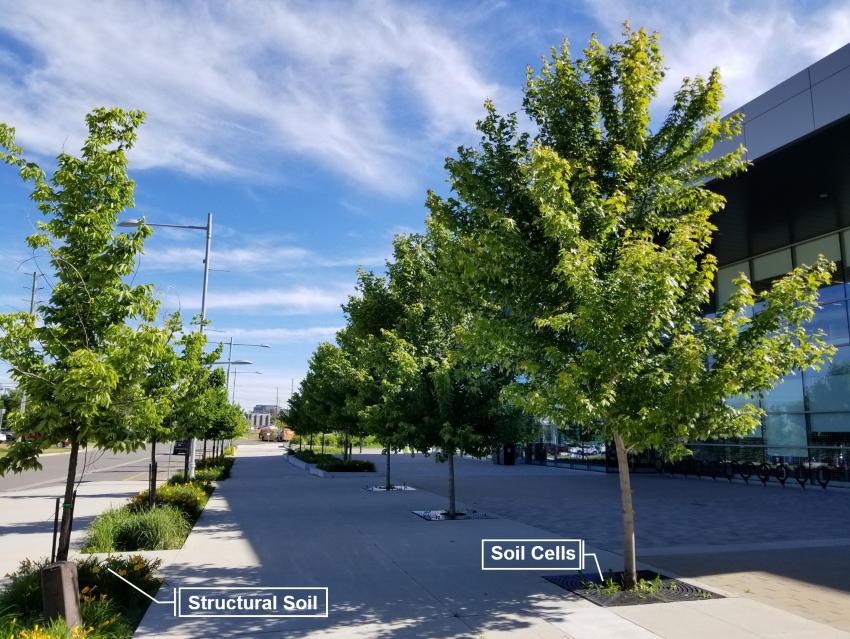
The Core Difference: Rootable Volume
Because 80% of structural soil is gravel, only 20% of its volume is available for root growth. To match the rootable volume of a soil cell system, you would need approximately 4.85 times more structural soil — a significantly larger excavation footprint, more spoil removal, and higher overall cost. What looks like the budget option rarely is when evaluated on equal terms.
Soil cells avoid the compaction tradeoff entirely. The structural load is carried by the framework, not the soil, so the growing medium stays loose and accessible at full depth.
What the Research Shows
Bartlett Tree Labs – Charlotte, NC
In 2014, Bartlett Tree Labs planted tulip poplars across six subsurface treatments designed to simulate city sidewalk conditions — two soil cell configurations, gravel-based structural soil, sand-based structural soil, and two compacted controls.
After 18 months, trees in soil cells reached 34–36 inches in height, while trees in gravel-based structural soil reached only 13 inches. Sand-based structural soil reached 17 inches. The compacted control — replicating typical urban conditions — produced just 3 inches of growth.
By year three, the gap had widened further. Trees in GreenBlue soil cells achieved 28.15 inches of new shoot extension, compared to 17.79 inches in sand-based structural soil and just 10 inches in gravel-based structural soil. Trunk diameter increase followed the same pattern — 6.29 inches in soil cells versus 4.33 inches in gravel-based structural soil and 0.29 inches in the compacted control.
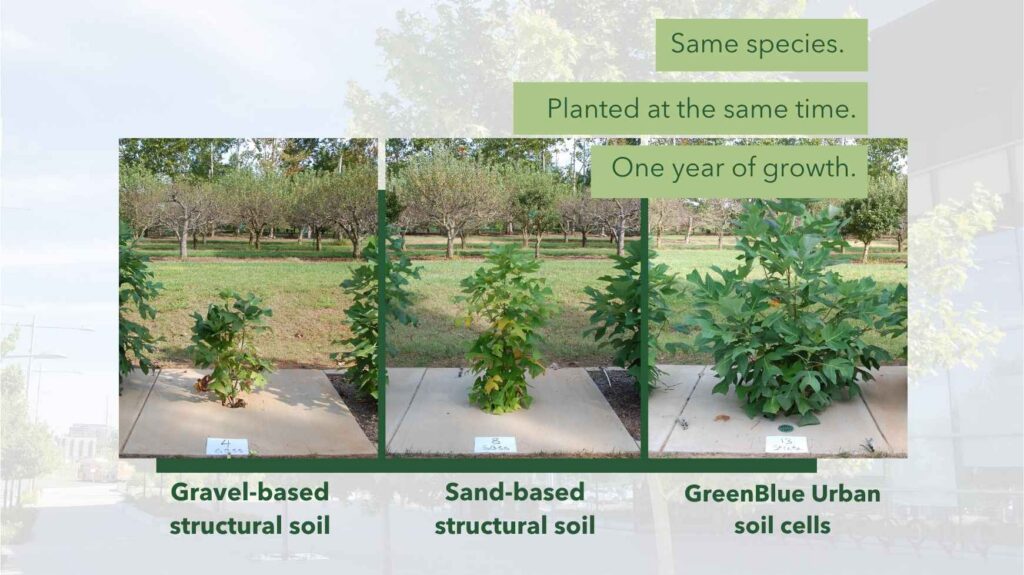
The study was originally intended to run for five to ten years but was condensed after year one due to the clarity of results. Dr. Thomas Smiley, Arboricultural Researcher at Bartlett, noted that large differences in tree health and growth were visible well before the data summary was complete, and that the photographs alone told most of the story.
Hadlow Field Trials – University of Greenwich, UK
One of the most extensive independent trials of below-ground urban tree planting media began at the University of Greenwich in 2013, with over 30 trees planted across a broad variety of products. Root radar scanning at year four showed trees in soil cells achieving root depths of 40 inches, compared to 12 inches in sand-based structural soil. Deeper roots matter beyond the growth numbers — they’re what allow urban trees to access moisture during drought and deliver meaningful canopy cover through hotter summers.
Linden Trees Case Study – Side-by-Side Street Planting
Perhaps the most visually compelling evidence comes from a real-world street planting where five linden trees were installed in 2011 — one end of the block planted using soil cells, the other in structural soil.
Seven years later, the difference was dramatic. The trees in soil cells developed into a full, mature canopy, reaching the second floor of the buildings lining the street. The trees in structural soil remain significantly smaller, struggling to establish in the limited rootable volume available to them. Same species, same location, same year planted — entirely different outcomes.
The True Cost Comparison
Structural soil is often perceived to be the lower-cost option, but several factors complicate that assumption. Because only 20% of structural soil is rootable, achieving equivalent soil volume with structural soil requires nearly five times the excavation area, driving up both excavation and spoil removal costs.
Trees that never properly establish will need replacement, creating a recurring expense that a well-specified soil cell system avoids. When the full lifecycle is accounted for, structural soil is rarely the savings it appears to be at bid time.
The Bottom Line
Across independent research trials and real-world installations on multiple continents, soil cells have consistently and significantly outperformed structural soil for urban tree growth.
The data is clear: soil cells provide more rootable volume, produce faster and healthier tree establishment, support stronger root systems, and deliver far better long-term outcomes for urban trees and the cities that depend on them.
To discuss how to design for long-term urban tree health on your next project, contact GreenBlue Urban’s technical team at inquiries@greenblue.com.
