

How to Plant Street Trees Around Utilities Without Damage
Urban environments are complex, high-demand spaces where every inch of land serves a function. Yet even in densely built areas, greenery is not optional — it’s essential. Street trees do far more than beautify communities. They improve air quality, mitigate urban heat, support biodiversity, intercept rainfall, stabilize soil, and contribute to healthier, more resilient neighborhoods.
Beyond environmental value, trees play a vital social and economic role. They provide shade, encourage outdoor activity, reduce stress, raise property values, and decrease cooling costs in heat-prone cities. For American cities facing climate challenges, integrating trees into urban design has become critical infrastructure work rather than a luxury. The challenge, however, is balancing healthy tree growth with the reality of complex underground utilities.
Why Planting Street Trees Around Utilities Is a Growing Urban Challenge
Under nearly every street and sidewalk lies a dense web of water lines, gas pipes, electric conduits, storm drains, fiber-optic cables, and communication systems. These utilities often occupy the same soil layers where tree roots naturally spread. Because roots are opportunistic and grow toward oxygen, moisture, and nutrients, they may follow utility trenches if soil volume elsewhere is limited.
But this conflict is solvable. With proper planning and well-engineered tree pit systems, trees can thrive without jeopardizing critical infrastructure.
Modern tree pit technologies — such as the GreenBlue Urban RootSpace system — allow shallow utilities to run above the structural soil cells, while deeper utilities can be integrated directly within the system. Understanding how roots behave is the first step toward designing trees and infrastructure that successfully coexist.
Key Principles for Planting Street Trees Around Utilities Safely
Soil Volume, Drainage, and Tree Pit Design Basics
Healthy tree growth depends on soil volume, drainage, and planting depth. Most tree roots develop in the top 24–32 inches of soil, the same zone commonly occupied by utilities. Effective tree pit design prioritizes lateral soil volume, allowing roots to spread safely while protecting surrounding infrastructure.
How Root-Guiding Barriers Protect Utilities and Promote Healthy Growth
Root barriers should not be seen as restrictive. They act as protective shields, steering roots away from vulnerable utilities and into engineered soil zones that support long-term health.
Why Proper Planting Depth Prevents Long-Term Tree Failure
Planting depth is equally critical, as trees are accustomed to specific nursery soil levels. Planting too deeply can suffocate roots and lead to rot, while planting slightly higher than the nursery depth ensures healthy growth.
Grates, guards, and structured soil cell systems protect the tree while preventing compaction, maintaining adequate drainage, and ensuring surrounding pavement remains safe and stable.
The Importance of Early Collaboration Between Designers and Utility Teams
Successful integration of trees and infrastructure requires early coordination among landscape architects, civil engineers, and utility companies. Utility plans are often indicative rather than precise, which requires flexibility and adaptability during implementation, especially in older downtown districts where sidewalks may be narrow, and utility congestion is high.
By engaging all stakeholders early, designers can identify less congested locations and integrate modular tree pit systems that accommodate the complexity of the urban environment. Modular tree pit systems allow designers to adapt shapes, sizes, and soil volumes around constraints without sacrificing tree health.
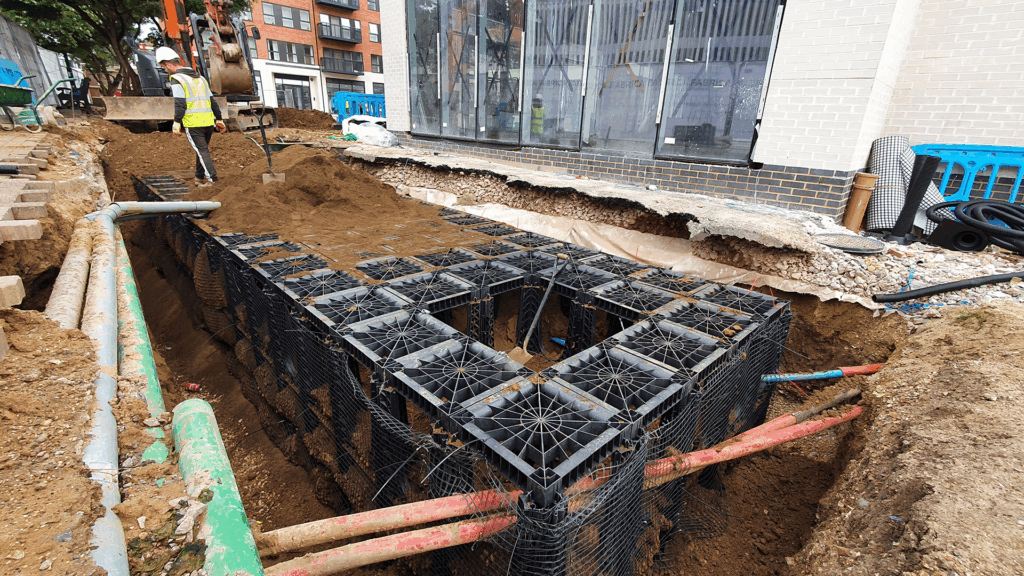
Modern Tree Pit Systems That Help Trees and Utilities Coexist
Modular tree pit systems have transformed how cities approach urban tree planting. Unlike traditional square pits with limited soil, modular soil cell systems:
- Provide significantly more usable soil volume
- Guide root growth safely around utilities
- Can be adjusted into irregular shapes to fit tight urban spaces
- Reduce sidewalk heaving and infrastructure damage
- Support long-term canopy development
Tree roots do not grow symmetrically, and pits do not need to be perfectly square. Modular systems embrace natural root behavior, allowing trees to establish strong, healthy root networks while protecting utility lines.
Although modern utility pipes with welded joints are generally resistant to intrusion, older clay or cracked pipes can attract roots. In those cases, sealing the pipes and using root-directing barriers ensures roots are guided toward safe, structured soil zones.
Creating Balance Between Urban Trees and Critical Infrastructure
Integrating street trees into areas crowded with utilities requires foresight and smart engineering, but the long-term benefits are undeniable.
The Economic Benefits of Mature Urban Trees
Urban trees:
- Improve property values
- Provide shade for pedestrians and cyclists
- Reduce urban heat islands
- Enhance public well-being
- Manage stormwater
- Strengthen climate resilience
How Engineered Soil Keeps Roots Away From Pavement and Utilities
Roots grow toward opportunity — toward water, air pockets, and nutrients. When designers provide those resources intentionally through well-designed tree pits, roots stay within the engineered soil, away from utilities, sidewalks, and roadways.
This proactive approach reduces maintenance costs, prevents service disruptions, and extends the lifespan of both trees and infrastructure. A strategically designed tree pit becomes an investment, not a compromise.
The Bigger Picture: Treating Tree Pits as Essential Urban Infrastructure
American cities face increasing challenges from climate stress, heat waves, and aging infrastructure. Integrating street trees effectively is one of the most cost-efficient strategies for improving resilience, public health, and environmental quality.
Utilities should not be viewed as obstacles but as design constraints that encourage innovation. With thoughtful design, modular soil systems, and multidisciplinary collaboration, cities can support large, healthy trees even in the most utility-dense environments.
