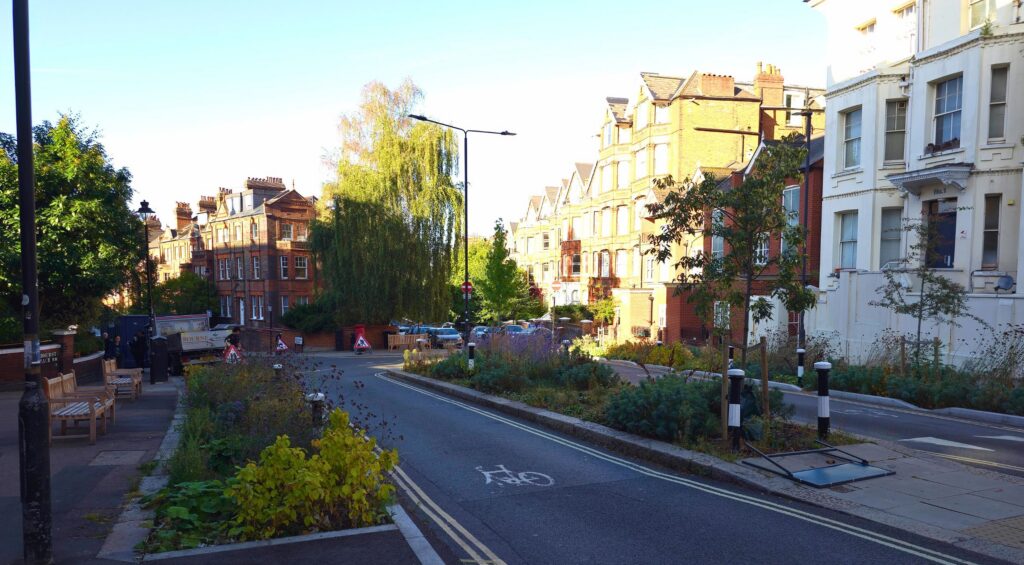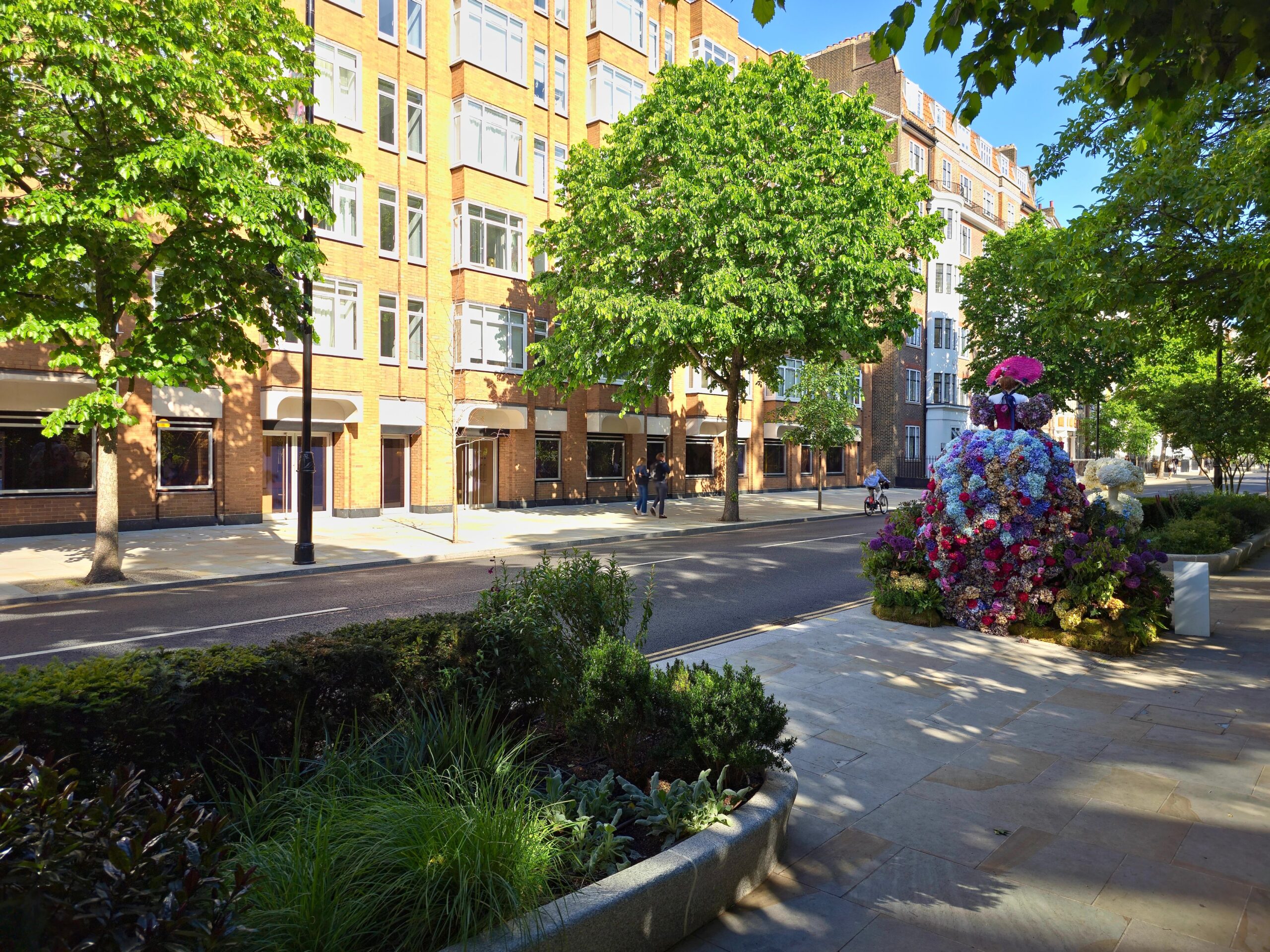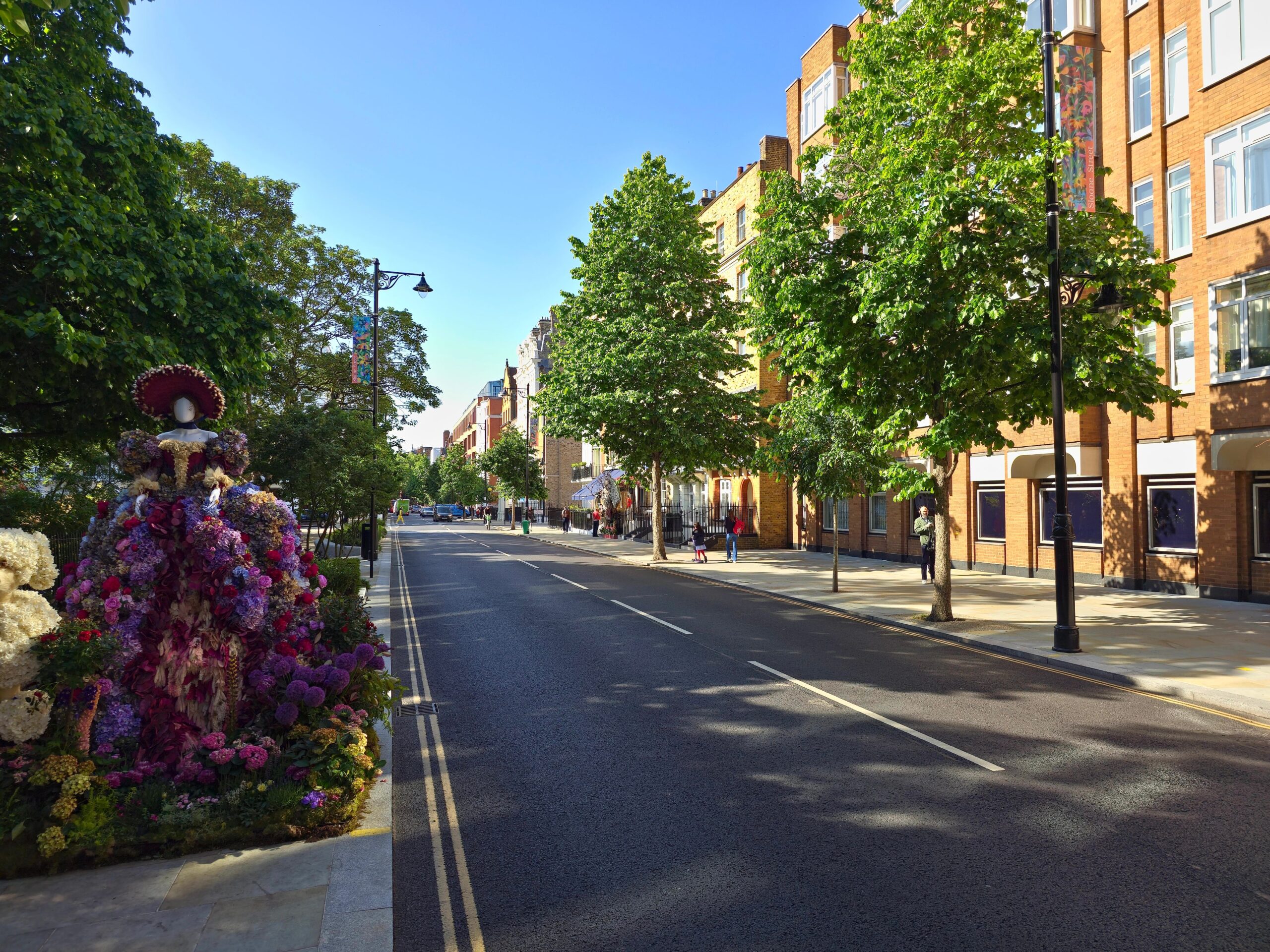



Sloane Street has undergone a £46 million public realm transformation to create a greener, more resilient and pedestrian-focused boulevard that reflects its status as one of London’s most prestigious streets.
The project was commissioned and delivered by Cadogan in partnership with the Royal Borough of Kensington and Chelsea, with John McAslan + Partners appointed as architects and masterplanners with Andy Sturgeon Design leading the landscape architecture.
The delivery of the scheme relied on close collaboration between the design team, specialist consultants, contractors and product manufacturers, with GreenBlue Urban providing the engineered soil cells that provides the long-term success of the street’s tree planting strategy.
Project
Location
Contractor
Landscape Architect
Sloane Street has undergone a £46 million public realm transformation to create a greener, more resilient and pedestrian-focused boulevard that reflects its status as one of London’s most prestigious streets.
The project was commissioned and delivered by Cadogan in partnership with the Royal Borough of Kensington and Chelsea, with John McAslan + Partners appointed as architects and masterplanners with Andy Sturgeon Design leading the landscape architecture.
The delivery of the scheme relied on close collaboration between the design team, specialist consultants, contractors and product manufacturers, with GreenBlue Urban providing the engineered soil cells that provides the long-term success of the street’s tree planting strategy.
Project
Location
Contractor
Landscape Architect
Project
Location
Contractor
Landscape Architect
Historical Context and Urban Challenges
Sloane Street, named after Sir Hans Sloane, whose landholdings shaped much of the surrounding area, the street was conceived as a grand route linking Knightsbridge to Sloane Square and Chelsea. Over many years of increased infrastructure, repairs and basement developments gradually eroded the quality of the streets, leaving pavements narrow with trees constrained to small, underperforming pits.
Recognising these issues, Cadogan and the Royal Borough of Kensington and Chelsea initiated a comprehensive regeneration to future-proof Sloane Street and align it with contemporary expectations for sustainability, climate resilience and pedestrian access. John McAslan + Partners developed a masterplan that rebalanced the street in favour of people, while Andy Sturgeon Design shaped a landscape strategy that placed trees and planting at the centre of the boulevard’s identity. The ambition was not simply to introduce more greenery, but to ensure that new trees could establish, grow and deliver meaningful environmental benefits over the long term.
Tree Strategy and Design Ambition
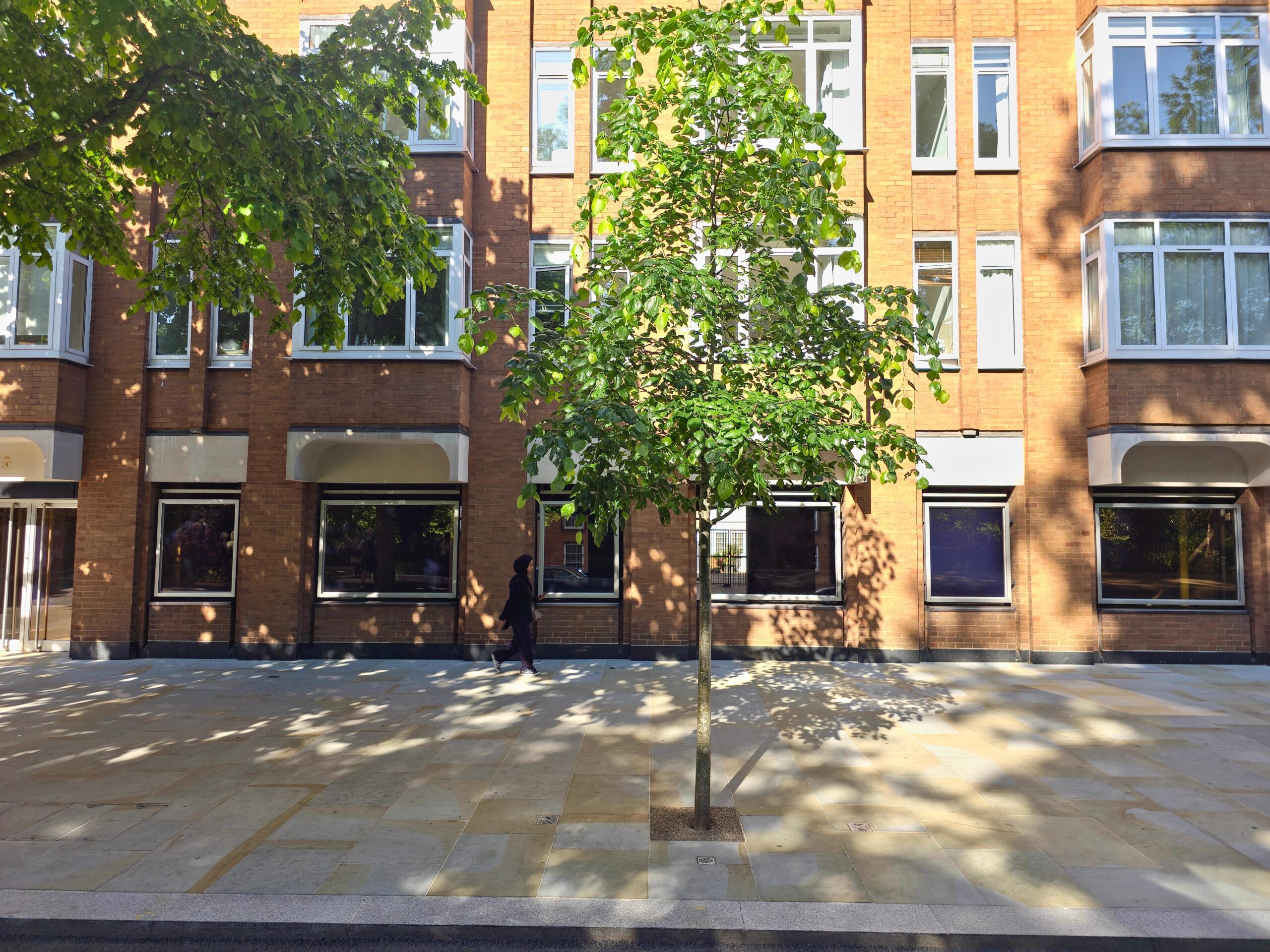
A key component of this approach was the introduction of over 100 new street trees forming a continuous green corridor along the length of Sloane Street. Species selection and spacing were carefully considered by Andy Sturgeon Design to provide shade, seasonal interest and resilience to pollution, drought and compacted urban conditions.
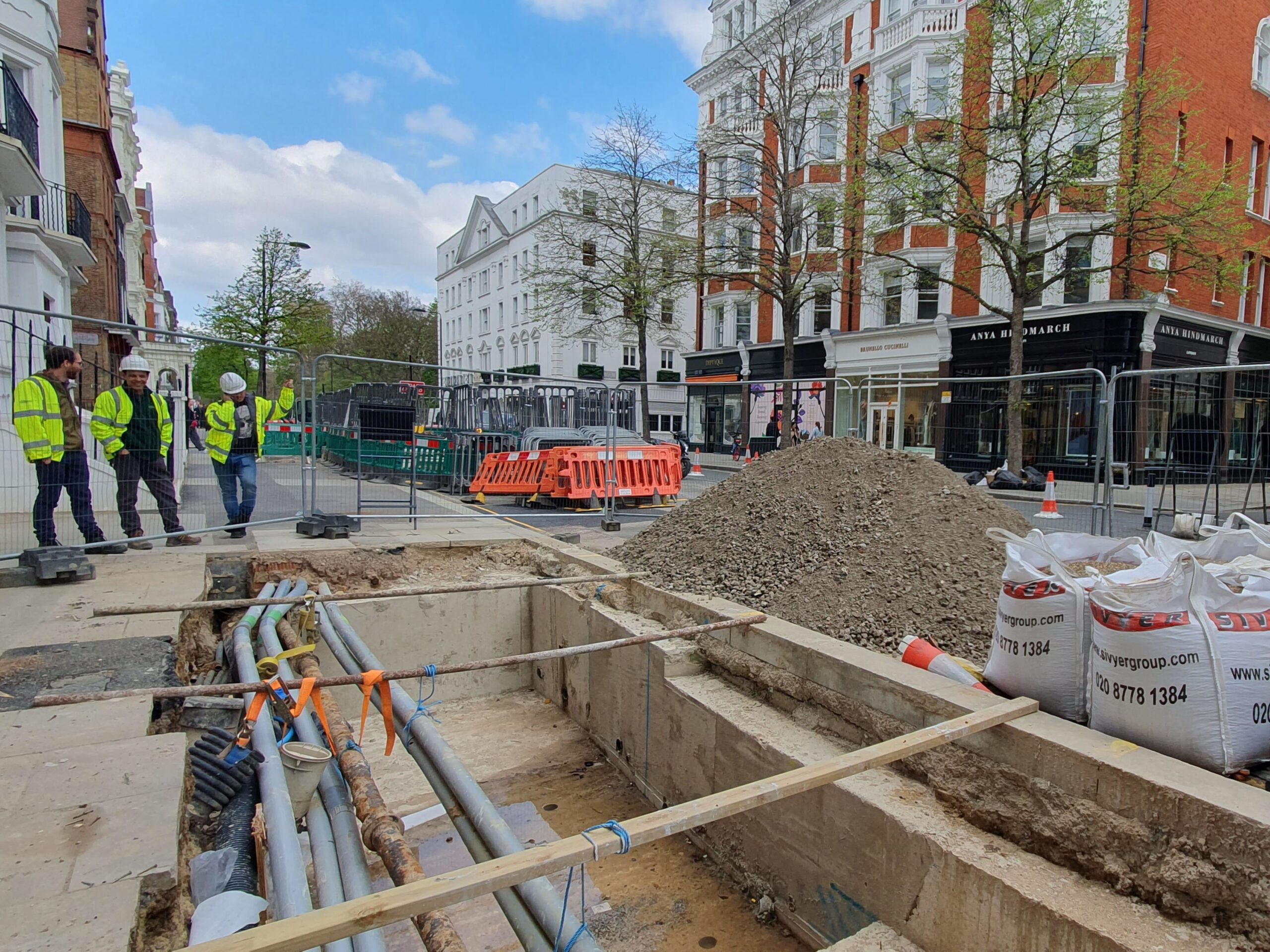
Delivering this vision presented significant technical challenges, as the street contains a dense network of utilities and extensive basement structures extending beneath the pavement. These constraints severely limited excavation depths.
To address these challenges, the project team worked closely with GreenBlue Urban to integrate the soil cell system beneath the new pavements. GreenBlue Urban RootSpace soil cells were selected for its ability to provide large volumes of uncompacted, load-bearing soil beneath heavily trafficked areas, allowing pavements to remain structurally robust while supporting healthy tree growth.
The modular nature of the system enabled it to be configured around existing utilities, minimising disruption and avoiding costly service diversions, while its shallow profile allowed installation above basement slabs without compromising adjacent structures.
To ensure the tree pit system operated as a fully integrated and seamless solution, a tool kit of components was incorporated. High-quality Zeta Square tree grilles provided a durable and visually refined surface finish, while ArborVent units facilitated essential soil aeration and gas exchange. ArborGuy anchor systems were installed to securely stabilise trees below ground without the need for above-ground supports, and RootRain Urban irrigation units enabled efficient watering directly to the root zone, demonstrating that long-term tree performance in challenging urban environments depends on every component working in unison rather than in isolation.
Historical Context and Urban Challenges
Sloane Street, named after Sir Hans Sloane, whose landholdings shaped much of the surrounding area, the street was conceived as a grand route linking Knightsbridge to Sloane Square and Chelsea. Over many years of increased infrastructure, repairs and basement developments gradually eroded the quality of the streets, leaving pavements narrow with trees constrained to small, underperforming pits.
Recognising these issues, Cadogan and the Royal Borough of Kensington and Chelsea initiated a comprehensive regeneration to future-proof Sloane Street and align it with contemporary expectations for sustainability, climate resilience and pedestrian access. John McAslan + Partners developed a masterplan that rebalanced the street in favour of people, while Andy Sturgeon Design shaped a landscape strategy that placed trees and planting at the centre of the boulevard’s identity. The ambition was not simply to introduce more greenery, but to ensure that new trees could establish, grow and deliver meaningful environmental benefits over the long term.
Tree Strategy and Design Ambition
A key component of this approach was the introduction of over 100 new street trees forming a continuous green corridor along the length of Sloane Street. Species selection and spacing were carefully considered by Andy Sturgeon Design to provide shade, seasonal interest and resilience to pollution, drought and compacted urban conditions.
Delivering this vision presented significant technical challenges, as the street contains a dense network of utilities and extensive basement structures extending beneath the pavement. These constraints severely limited excavation depths.
To address these challenges, the project team worked closely with GreenBlue Urban to integrate the soil cell system beneath the new pavements. GreenBlue Urban RootSpace soil cells were selected for its ability to provide large volumes of uncompacted, load-bearing soil beneath heavily trafficked areas, allowing pavements to remain structurally robust while supporting healthy tree growth.
The modular nature of the system enabled it to be configured around existing utilities, minimising disruption and avoiding costly service diversions, while its shallow profile allowed installation above basement slabs without compromising adjacent structures.
To ensure the tree pit system operated as a fully integrated and seamless solution, a tool kit of components was incorporated. High-quality Zeta Square tree grilles provided a durable and visually refined surface finish, while ArborVent units facilitated essential soil aeration and gas exchange. ArborGuy anchor systems were installed to securely stabilise trees below ground without the need for above-ground supports, and RootRain Urban irrigation units enabled efficient watering directly to the root zone, demonstrating that long-term tree performance in challenging urban environments depends on every component working in unison rather than in isolation.
Working with Existing Infrastructure and Heritage
The system effectively transformed isolated tree pits into connected underground soil environments, allowing roots to spread laterally and access water, oxygen and nutrients well beyond the immediate planting location. The project ensured that trees were treated as permanent urban infrastructure rather than decorative elements.
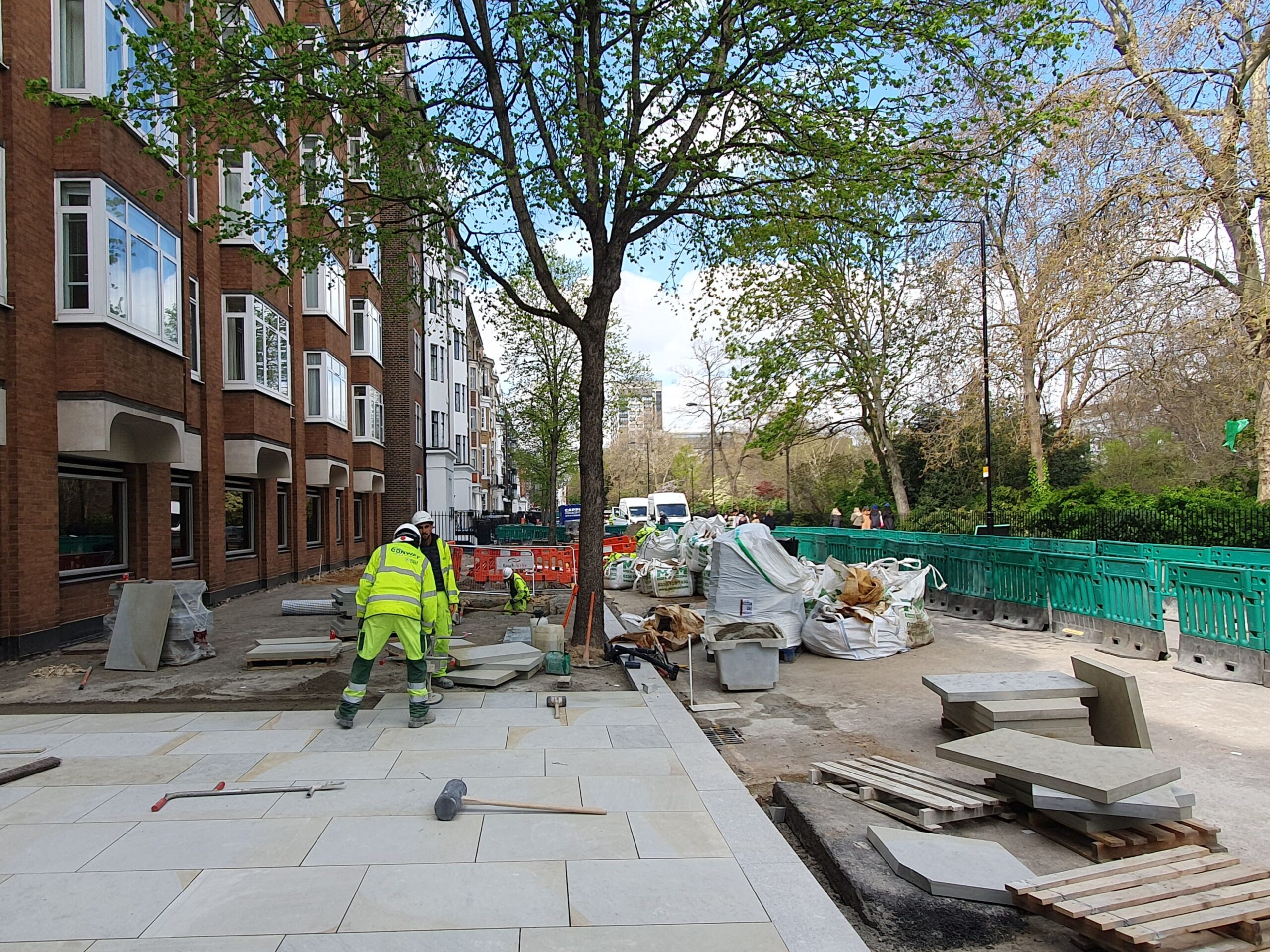
Completed in 2024, the Sloane Street regeneration stands as a collaborative achievement between client, designers, engineers, specialist suppliers and FM Conway as installers. It demonstrates how carefully coordinated masterplanning, landscape architecture and engineered tree pit systems can overcome extreme spatial constraints in dense urban environments.
Long-Term Outcomes
By investing in robust below-ground solutions such as GreenBlue Urban’s RootSpace, Cadogan and the Royal Borough of Kensington and Chelsea have set a new benchmark for street tree design and public realm regeneration in London, delivering a boulevard where trees are designed to thrive for decades while enhancing environmental performance, pedestrian experience and the long-term identity of Sloane Street.
GreenBlue Urban’s system was chosen not only for its technical performance, but for its ability to work sensitively within the complex realities of Sloane Street. Its flexible, modular design allowed the new landscape to be threaded carefully around historic fabric, constrained basements and layers of legacy infrastructure, avoiding invasive interventions while preserving the character of this distinguished setting.
In doing so, the project demonstrates how contemporary urban greening solutions can enhance environmental performance without compromising the heritage, continuity or long-established identity of one of London’s most celebrated streets.
Working with Existing Infrastructure and Heritage
The system effectively transformed isolated tree pits into connected underground soil environments, allowing roots to spread laterally and access water, oxygen and nutrients well beyond the immediate planting location. The project ensured that trees were treated as permanent urban infrastructure rather than decorative elements.
Completed in 2024, the Sloane Street regeneration stands as a collaborative achievement between client, designers, engineers, specialist suppliers and FM Conway as installers. It demonstrates how carefully coordinated masterplanning, landscape architecture and engineered tree pit systems can overcome extreme spatial constraints in dense urban environments.
Long-Term Outcomes
By investing in robust below-ground solutions such as GreenBlue Urban’s RootSpace, Cadogan and the Royal Borough of Kensington and Chelsea have set a new benchmark for street tree design and public realm regeneration in London, delivering a boulevard where trees are designed to thrive for decades while enhancing environmental performance, pedestrian experience and the long-term identity of Sloane Street.
GreenBlue Urban’s system was chosen not only for its technical performance, but for its ability to work sensitively within the complex realities of Sloane Street. Its flexible, modular design allowed the new landscape to be threaded carefully around historic fabric, constrained basements and layers of legacy infrastructure, avoiding invasive interventions while preserving the character of this distinguished setting.
In doing so, the project demonstrates how contemporary urban greening solutions can enhance environmental performance without compromising the heritage, continuity or long-established identity of one of London’s most celebrated streets.

Please wait while you are redirected to the right page...